


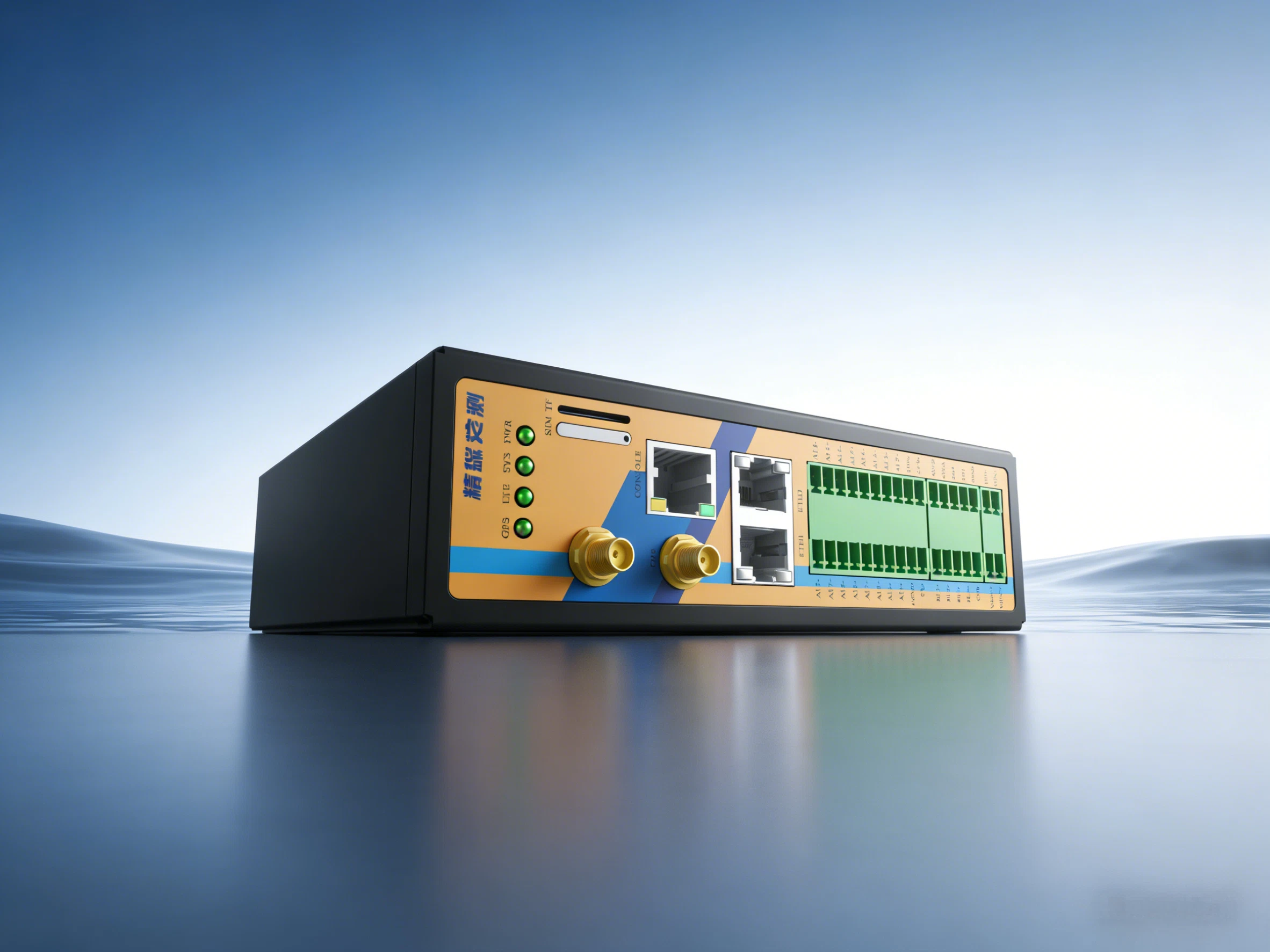
Water Hammer/Leak Monitoring System
Application Field
Application scenarios
Pipe burst monitoring: Pipe bursts will affect a wide range of social production and life, causing a large number of complaints. The erosion and retention of large amounts of water in a short period of time may also cause secondary disasters such as damage to surrounding buildings. It needs to be discovered and located as soon as possible.
Leakage monitoring: On the one hand, leakage causes the loss of water, and on the other hand, it causes the loss of heat energy; at the same time, the erosion of water flow will take away the soil around the pipe, worsening the stress state of the pipeline structure, and aggravating the damage of the pipeline.
- Water hammer monitoring: When the flow rate of water in the pipeline changes drastically, water hammer will occur. The water hammer may exceed several times the working pressure and cause damage to valves, pipeline interfaces, etc.
Monitoring principle
The high-frequency pressure sensor senses the pressure fluctuations in the pipe in real time, and uses an adaptive recognition algorithm to identify water hammer and the negative pressure waves generated by pipe bursts and leaks; the high-sensitivity hydrophone senses the acoustic signals generated by leaks in real time; the wave arrival time difference is used to locate water hammer, pipe bursts, and leaks, and the multi-path pipe network algorithm enhances the positioning accuracy of complex topology pipe networks.
Use AI deep learning neural network algorithms to improve the accuracy of identifying water hammer, pipe bursts, and leakage events, and reduce the rate of false alarms and false negatives. For water transmission and distribution pipelines, the distance between monitoring sections is about 13km; for municipal pipe networks, the distance between monitoring sections is about 0.81~1.5km.
Product features
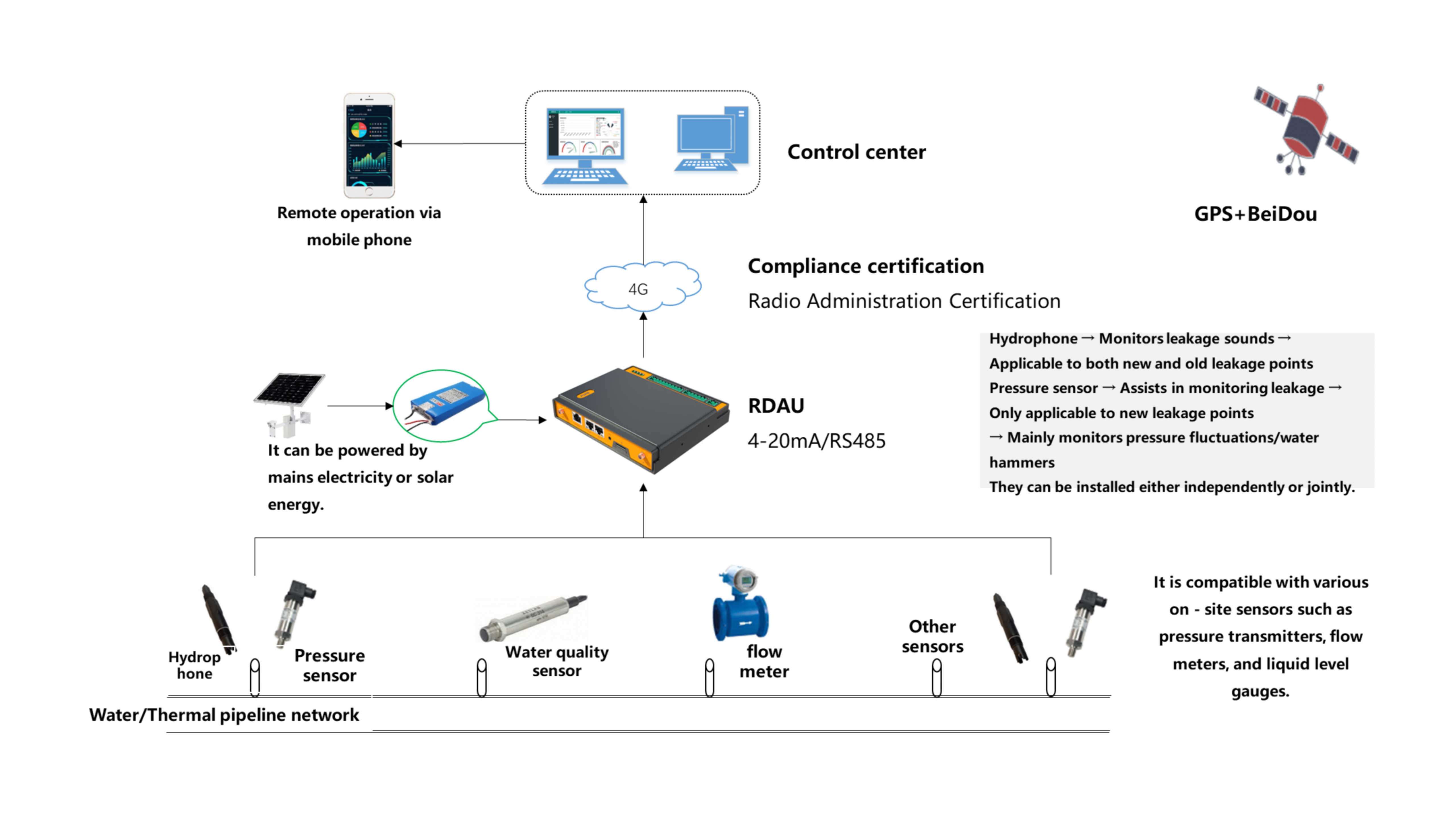
The system consists of high-frequency pressure sensors, high-sensitivity hydrophones, remote control terminals RDAU, power supply units, and control center software and hardware systems. The interfaces reserved by RDAU can be connected to flow meters, water quality sensors, etc., and can be integrated into the monitoring system.
- Adopt keep-alve heartbeat link monitoring mechanism and abnormal self-recovery;
- A data reissue mechanism is adopted to proactively reissue data when the network recovers to ensure that data is not lost;
- Supports 16bit high-frequency real-time acquisition, with a maximum frequency of 50kHz;
- Supports simultaneous access of multiple pressure sensors, hydrophone sensors, flow meters, liquid level meters, etc.;
- Support edge computing such as local data preprocessing to reduce cloud load;
- Supports Beidou/GPS and NTP dual clocks to ensure accurate clock synchronization across the entire network;
- The cloud forwarding engine is used to penetrate the local area network and adapt to high concurrency and high throughput application scenarios;
- The data comes with time tags, and supports continuous upload, scheduled upload, and adjustment of sampling frequency and data upload time.
- Hardware capabilities: 32G large capacity/60 days cache, 9~36V wide voltage power supply, built-in optional rechargeable lithium battery.